
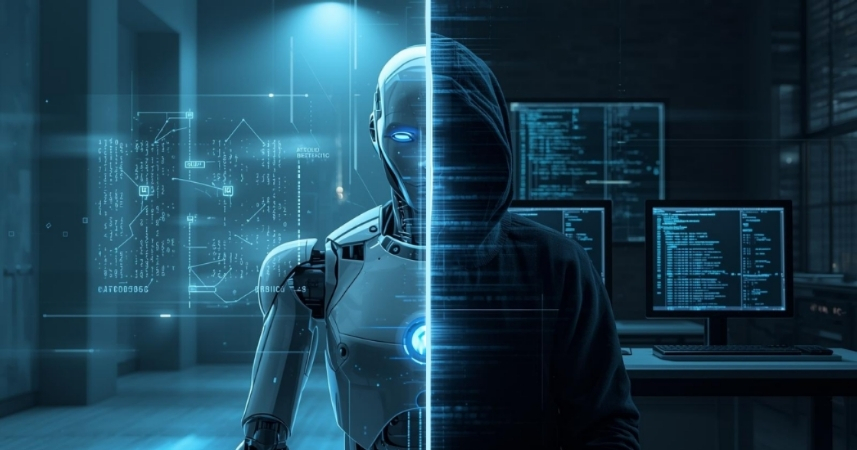
Artificial Intelligence (AI) is changing the cybersecurity game for both defenders and attackers.
In 2025, it’s no longer just humans fighting hackers; it’s AI vs. AI.
While AI-driven security systems can detect and neutralize threats in milliseconds, cybercriminals are also using AI to launch faster, smarter, and more deceptive attacks.
The result? A high-speed, ever-evolving battle between algorithms one defending, the other destroying.
So, who wins?
1. The AI Advantage: Smarter Cyber Defence
Cybersecurity has always been a race against time. Traditional tools depend on human analysts, who can’t keep up with today’s massive, complex data streams.
This is where AI in cybersecurity shines.
AI-powered defence systems can:
- Analyse billions of data points in real time.
- Detect anomalies that signal potential breaches.
- Automate incident response within seconds.
- Learn from past attacks and improve continuously.
For instance, machine learning models can recognize subtle patterns that indicate insider threats, ransomware behaviour, or phishing attempts long before humans notice.
According to cybersecurity experts, AI-driven threat detection has reduced average response times from hours to seconds a game-changer in 2025’s fast-moving cyber landscape.
2. The Dark Side: When Hackers Use AI
Unfortunately, AI isn’t just a weapon for good. Cybercriminals are now harnessing AI algorithms to amplify their attacks making them faster, stealthier, and more convincing.
Examples of AI-powered attacks include:
- Deepfake Phishing: Using AI-generated voices and videos to impersonate CEOs, managers, or colleagues in real-time.
- Automated Breaches: Bots that scan for vulnerabilities, crack passwords, and exploit systems without human involvement.
- Adaptive Malware: Malware that changes its code automatically to evade detection.
- AI Social Engineering: Systems that analyse online behaviour to craft hyper-personalized scams.
These intelligent attacks are harder to detect because they continuously evolve and learn, just like legitimate AI defences.
3. AI vs. AI: The Cybersecurity Arms Race
What happens when both sides use AI?
Welcome to the new digital arms race AI vs. AI.
Defensive AI models now battle offensive AI in real time:
- Defensive algorithms monitor and predict suspicious behaviour.
- Offensive AI mutates and adapts to avoid being detected.
The result is a continuous loop of adaptation a cyber tug-of-war where both sides get smarter every second.
This arms race is pushing organizations to build ethical, explainable AI models that can identify not just threats, but how those threats evolve.
4. The Rise of Autonomous Cyber Defence
In 2025, the future of cybersecurity lies in autonomous defence systems intelligent frameworks capable of acting without human intervention.
These systems combine:
- Machine learning for pattern detection.
- Behavioural analytics for anomaly detection.
- Automation for real-time containment and recovery.
For example, if an AI system detects abnormal data access at midnight from an unusual IP address, it can isolate the endpoint, block the user, and notify security teams instantly all before damage occurs.
Autonomous defence is not just faster, it’s predictive.
It can anticipate cyber threats before they happen, using predictive analytics based on historical and real-time data.
5. Ethical AI: The New Frontier in Cybersecurity
As AI grows stronger, ethics and transparency become crucial.
If AI can both protect and attack, the line between right and wrong becomes blurred.
That’s why cybersecurity experts are focusing on:
- Ethical AI frameworks that prevent misuse.
- Explainable AI (XAI) to make security decisions transparent.
- Regulation and compliance to stop malicious AI development.
Organizations must ensure that their AI models are secure, fair, and tamper-proof because a hacked AI is infinitely more dangerous than a human hacker.
6. The Human Element Still Matters
Despite automation, the human factor remains vital.
AI can analyse and respond, but human intuition and ethical judgment guide long-term strategy.
Security professionals must learn to collaborate with AI tools, not compete with them combining machine precision with human insight to create a hybrid cybersecurity model that’s proactive, adaptive, and ethical.
7. The Future: Coexistence, Not Competition
The future of cybersecurity isn’t AI replacing humans, it’s AI and humans defending together.
AI will handle the scale and speed, while humans provide reasoning, oversight, and creativity.
In this symbiotic model, organizations will gain resilience, agility, and foresight crucial qualities in a world where AI-powered hackers never sleep.
Conclusion: The Battle Has Just Begun
AI vs. Hackers isn’t just a future scenario, it’s happening right now.
As both sides grow smarter, the only way to win is through constant evolution, collaboration, and ethical AI adoption.
The cybersecurity war of tomorrow won’t be fought by people alone, it’ll be a clash of algorithms, guided by intelligence, ethics, and adaptability.
So, who wins?
The side that learns faster.